
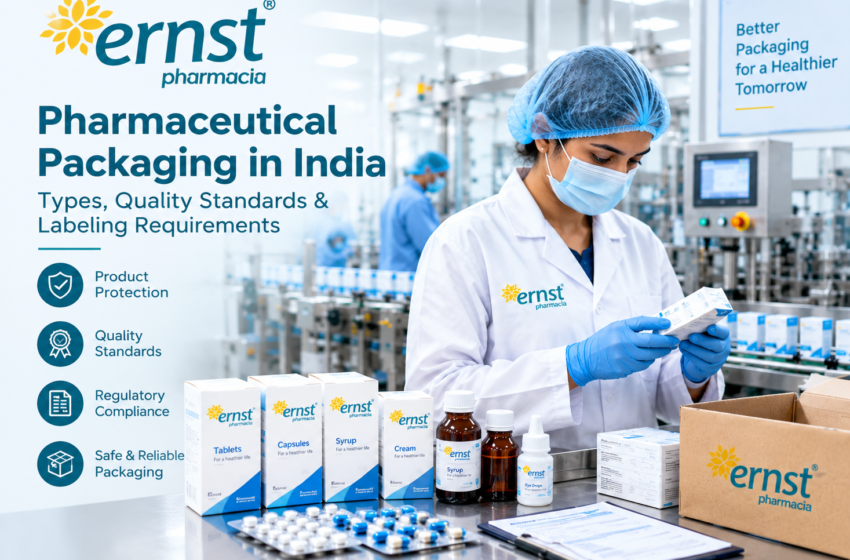
Pharmaceutical packaging is an important part of the medicine manufacturing process. It helps protect medicines from moisture, light, contamination, physical damage, and other factors that may affect their quality during storage and transportation. Proper packaging also provides essential product information and helps healthcare professionals, distributors, pharmacists, and consumers identify medicines correctly.
In India, pharmaceutical packaging must be selected according to the medicine’s formulation, stability requirements, intended storage conditions, and applicable regulatory requirements. Tablets, capsules, syrups, injections, creams, eye drops, and other pharmaceutical products may require different packaging materials and systems.
For pharmaceutical companies, distributors, and businesses working with manufacturing partners, understanding pharmaceutical packaging can help improve product handling, documentation, supply-chain management, and quality oversight.
This guide explains the main types of pharmaceutical packaging in India, commonly used packaging materials, labeling requirements, quality checks, and the factors businesses should consider when selecting a pharmaceutical manufacturing partner.
What Is Pharmaceutical Packaging?
Pharmaceutical packaging refers to the materials and systems used to contain, protect, identify, store, and distribute medicines. It includes the immediate container that holds a product, the outer packaging, and any accompanying labels, leaflets, or instructions.
The packaging system must be suitable for the particular medicine. For example, a tablet may require a moisture-resistant blister pack, while an oral liquid may need a compatible bottle with a secure closure.
Pharmaceutical packaging serves several purposes:
- Product protection: Helps protect medicines from environmental exposure and physical damage.
- Product identification: Displays the product name, strength, batch details, and other required information.
- Quality maintenance: Helps preserve the medicine’s quality throughout its approved shelf life when used with suitable storage conditions.
- Safe handling: Supports appropriate storage, transportation, and dispensing.
- Regulatory compliance: Helps provide the labeling and traceability information required under applicable regulations.
- Tamper evidence: Certain packaging systems can help indicate whether a pack has been opened or interfered with.
The packaging system should be selected and validated for the specific product rather than chosen only on the basis of appearance or cost.
Why Is Pharmaceutical Packaging Important?
Pharmaceutical products can be sensitive to humidity, temperature, oxygen, light, and contamination. Packaging is one of the controls used to protect a medicine from these conditions.
1. Protecting Product Quality
Packaging materials must be compatible with the formulation and suitable for the intended storage conditions. Poor material selection or an unsuitable closure can affect the product’s stability or physical condition.
2. Supporting Medicine Identification
Clear and legible labels help distinguish between products with different names, strengths, formulations, or intended uses. This is especially important when products have similar packaging designs.
3. Supporting Storage and Transportation
Packaging should be appropriate for the expected distribution environment. Products that require special storage conditions need handling and transport arrangements that support those conditions.
4. Providing Essential Information
Pharmaceutical labels communicate required information, such as the product name, batch number, manufacturing details, expiry information, and applicable warnings or directions.
5. Supporting Traceability
Batch information and applicable identification codes can help businesses track products through the supply chain and investigate quality complaints or recalls when necessary.
Types of Pharmaceutical Packaging in India
Pharmaceutical packaging is generally discussed in three levels: primary, secondary, and tertiary packaging. The exact combination depends on the product and its distribution requirements.
1. Primary Pharmaceutical Packaging
Primary packaging is the packaging that directly contains or comes into direct contact with the medicine.
Common examples include:
- Blister packs for tablets and capsules
- Bottles for oral liquids
- Tubes for creams and ointments
- Vials and ampoules for injectable products
- Containers for eye and ear drops
- Sachets for selected powders and granules
Primary packaging requires careful material selection because it can directly affect the product’s protection and compatibility.
2. Secondary Pharmaceutical Packaging
Secondary packaging surrounds or groups the primary pack. It may provide additional protection, product information, and space for required labeling.
Examples include:
- Printed cartons for medicine strips
- Outer boxes for bottles
- Cartons containing tubes or dropper bottles
- Product information leaflets and inserts
- Multipacks where permitted and appropriate
The information printed on secondary packaging must remain consistent with the approved product details and applicable labeling requirements.
3. Tertiary Pharmaceutical Packaging
Tertiary packaging supports bulk handling, warehousing, and transportation.
Examples include:
- Corrugated shipping cartons
- Protective dividers
- Pallets and stretch wrapping
- Outer transport containers
The purpose is to reduce the risk of damage during movement and help maintain organized inventory handling.
Common Pharmaceutical Packaging Materials
Different materials offer different protective properties. Their suitability depends on the medicine, formulation, storage requirements, and compatibility data.
| Packaging material | Common applications | Important considerations |
|---|---|---|
| PVC and suitable barrier blister materials | Tablets and capsules | Moisture and light protection must suit the product |
| Aluminium foil | Blister lidding and selected packaging systems | Seal integrity, compatibility, and protection requirements |
| HDPE bottles | Selected tablets, capsules, and oral products | Closure compatibility and moisture protection |
| PET bottles | Selected liquid and solid oral products | Product compatibility and barrier performance |
| Glass containers | Selected liquids, vials, and injectable products | Chemical compatibility, breakage risk, and closure integrity |
| Laminated tubes | Creams, gels, and ointments | Compatibility, sealing, and product protection |
| Rubber stoppers and specialised closures | Selected vials and injectable products | Compatibility, container-closure integrity, and product-specific requirements |
This table is a general guide, not a universal specification. A packaging material that is suitable for one formulation may not be suitable for another.
Pharmaceutical Packaging Types by Dosage Form
The formulation plays a major role in selecting an appropriate packaging system.
Tablets and Capsules
Tablets and capsules may be packed in blister strips, strip packs, or bottles, depending on the product and its stability requirements.
Important checks include:
- Protection against moisture and other relevant environmental factors
- Correct product strength and pack configuration
- Seal integrity
- Legibility of batch and expiry details
- Correct printed packaging materials
Syrups and Oral Suspensions
Oral liquids are commonly supplied in suitable bottles with compatible closures. Depending on the formulation, a measuring device or additional instructions may be required.
Important considerations include bottle compatibility, closure integrity, leakage prevention, and the storage conditions specified for the product.
For oral liquids, packaging must not replace appropriate manufacturing controls, finished-product testing, or product-specific stability studies.
Creams, Gels, and Ointments
Topical products may use laminated tubes, suitable plastic containers, or other compatible packaging systems.
The material should protect the formulation, support suitable dispensing, and maintain the required closure integrity throughout the product’s shelf life.
Injections and Infusions
Injectable products require packaging systems designed for the particular formulation and its sterility requirements. Depending on the product, these may include glass vials, ampoules, infusion containers, or other approved systems.
Relevant considerations include:
- Container-closure integrity
- Compatibility with the formulation
- Sterility-related requirements
- Particulate and contamination controls
- Appropriate storage conditions
The packaging system and associated processes must be suitable for the specific injectable product.
Eye Drops and Other Drop Preparations
Eye drops require suitable containers and closures that support the product’s quality and intended use. Depending on the formulation, the container may need to meet specific requirements for sterility, dispensing, and closure integrity.
The packaging must be selected according to the product’s approved specifications.
Pharmaceutical Labeling Requirements in India
Pharmaceutical labeling is a regulatory responsibility. The applicable requirements depend on the type of product, its classification, the intended market, and the relevant provisions of Indian law.
The Drugs and Cosmetics Act, 1940, the Drugs Rules, 1945, and applicable amendments provide important requirements for drug manufacturing, packaging, and labeling. Companies should check the current rules and product-specific requirements before approving any artwork or printed packaging material.
Depending on the product and applicable rules, labeling information may include:
- Name of the medicine
- Active ingredients and their quantities, where required
- Dosage form and strength
- Batch or lot number
- Manufacturing licence details, where required
- Manufacturing date and expiry information
- Manufacturer details
- Storage conditions
- Required warnings and statutory declarations
- Maximum retail price and other applicable declarations
- Directions or other information required for the product
Not every label has the same requirements. The applicable legal provisions should be checked for each product and packaging level.
Why Label Accuracy Matters
Incorrect or inconsistent labeling can lead to product identification problems, regulatory issues, and difficulties during distribution.
Before a batch is packaged and released, the responsible teams should verify the approved artwork, product details, batch information, and relevant packaging records.
A documented review process can help reduce errors such as:
- Incorrect product strength
- Mismatched batch details
- Wrong manufacturing or expiry information
- Use of outdated artwork
- Incorrect statutory declarations
- Mixing of printed materials belonging to different products
Barcode and QR Code Requirements
Indian drug rules include barcode or QR code provisions for specified drug formulation products listed under Schedule H2, including the identified top 300 brands. Separate QR code requirements also apply to active pharmaceutical ingredients under the relevant rules.
Businesses should verify whether a particular product is covered, which packaging level is applicable, and what information must be encoded. These requirements should not be assumed to apply identically to every medicine.
Pharmaceutical Packaging Quality Control
Packaging quality checks help confirm that the right materials, labels, and containers are used and that the packaging process follows approved procedures.
1. Incoming Packaging Material Inspection
Packaging materials should be checked against approved specifications when received. Depending on the material, checks may include dimensions, material identity, printing, physical condition, and relevant supplier documentation.
2. Artwork and Label Verification
The approved artwork should be compared with the printed material before use. Product names, strengths, batch coding areas, statutory declarations, and other required details should be reviewed.
3. Line Clearance
Before packaging a new product or batch, the packaging area should be checked to reduce the risk of leftover materials or labels from a previous batch causing a mix-up.
4. In-Process Packaging Checks
Checks during packaging may include correct pack configuration, coding accuracy, sealing, container condition, and other product-specific requirements.
5. Seal and Closure Integrity
The packaging system should maintain the required level of protection. Appropriate checks depend on the type of container, closure, and product.
6. Reconciliation of Printed Materials
Printed labels and packaging components should be controlled and reconciled according to the applicable procedures. Unused, damaged, or rejected materials should be handled and documented appropriately.
7. Batch Documentation
Relevant packaging records should identify the materials used, the checks performed, any deviations, and the personnel or processes involved, as required by the applicable quality system.
India’s revised Schedule M addresses Good Manufacturing Practices and requirements for manufacturing premises, plant, and equipment. It includes controls relevant to labeling and printed packaging materials. Companies should refer to the current applicable regulatory text and implementation requirements when designing their quality systems.
What Is Schedule M and Why Does It Matter for Packaging?
Schedule M forms part of India’s Drugs Rules and addresses Good Manufacturing Practices and requirements for pharmaceutical manufacturing premises, plant, and equipment.
Packaging-related controls form part of the broader quality system. They help prevent mix-ups, maintain records, and ensure that packaging and labeling activities are appropriately controlled.
The revised Schedule M was notified in December 2023. Government updates have described its implementation timelines, including requirements that became effective for manufacturers with turnover below ₹250 crore from 1 January 2026 following an extension. Manufacturers should confirm the provisions and implementation requirements applicable to their own premises and licences.
Schedule M compliance should be assessed through the relevant manufacturing and quality documentation rather than inferred solely from a marketing statement.
How to Choose the Right Pharmaceutical Packaging Partner
For businesses outsourcing pharmaceutical manufacturing or packaging, selecting a suitable partner requires more than comparing the price of a bottle, carton, or blister strip.
1. Verify the Relevant Manufacturing Facility
Ask which facility will manufacture and package the specific product. Review the applicable licences, certifications, and documentation rather than relying on general company-level claims.
2. Review Packaging Capabilities
Confirm whether the facility can handle the required dosage form, pack size, material, closure, and labeling configuration.
3. Ask About Quality Control
Understand how incoming materials are checked, how printed artwork is approved, how packaging-line clearance is performed, and how deviations are documented.
4. Check Product Compatibility and Stability
Packaging should be supported by appropriate product-specific compatibility and stability information. Do not select materials only because they are commonly used for similar medicines.
5. Confirm Labeling and Artwork Approval
Agree on responsibility for preparing, reviewing, approving, and updating artwork. Confirm the process for managing changes to product information or statutory requirements.
6. Understand Minimum Order Quantities and Timelines
Minimum order quantities, packaging availability, artwork approval, and production schedules vary by product and facility. Request written confirmation for the specific order.
7. Review Traceability and Complaint Handling
Ask how batch records are maintained, how product complaints are investigated, and how packaging-related issues are escalated and documented.
How Ernst Pharmacia Fits into Pharmaceutical Manufacturing
Ernst Pharmacia operates in India’s pharmaceutical sector and lists third-party manufacturing among its business services. Its official website describes a portfolio of more than 1,800 brands across multiple therapeutic categories and products manufactured through WHO-GMP-certified facilities.
For businesses evaluating Ernst Pharmacia for a pharmaceutical product or manufacturing requirement, the next step is to confirm the details relevant to the specific product and order.
Questions to discuss with the company include:
- Which dosage forms and pack configurations are available for the required product?
- Which manufacturing facility will be responsible for the product?
- What licences, product approvals, and quality documents can be provided?
- Which packaging materials and pack sizes are available?
- Who is responsible for artwork review and label compliance?
- What are the minimum order quantity, commercial terms, and estimated timeline?
- How are packaging complaints and product-quality concerns handled?
These details should be confirmed directly rather than assumed to be identical across all products.
To discuss a specific requirement, visit the official Ernst Pharmacia website or its contact page.
Common Pharmaceutical Packaging Mistakes to Avoid
Businesses can reduce packaging-related risks by avoiding the following mistakes:
- Choosing packaging only on price: Low-cost material may not provide the protection required for a particular formulation.
- Using unapproved artwork: Printed materials should follow the approved version and applicable labeling requirements.
- Ignoring material compatibility: Containers and closures must be suitable for the product.
- Overlooking batch coding: Batch and expiry information must be accurate and legible where required.
- Failing to control packaging materials: Poor segregation or reconciliation can increase the risk of mix-ups.
- Assuming all products follow identical rules: Labeling and packaging requirements can vary by product category.
- Not reviewing transport conditions: Outer packaging should be suitable for the expected storage and distribution environment.
- Accepting unsupported compliance claims: Verify relevant licences, certificates, and documentation for the specific facility and product.
The Future of Pharmaceutical Packaging in India
Pharmaceutical packaging continues to develop as manufacturers and supply-chain businesses focus on product protection, traceability, process control, and responsible material use.
Important areas include:
- Digital identification: Barcodes and QR codes can support identification and traceability where applicable.
- Improved packaging controls: Better inspection systems and documented procedures can help reduce labeling and packing errors.
- Product-specific packaging: Material selection is increasingly focused on the requirements of individual formulations.
- Tamper-evident systems: Appropriate designs can help indicate whether a package has been interfered with.
- Responsible material choices: Companies can assess material use, recyclability, and waste reduction while maintaining product safety and regulatory compliance.
New packaging technologies must still meet the requirements applicable to the product and market. Innovation should not compromise medicine quality or essential packaging functions.
Frequently Asked Questions
What is pharmaceutical packaging?
Pharmaceutical packaging is the system used to contain, protect, identify, store, and distribute medicines. It includes primary packaging such as blister packs and bottles, secondary packaging such as cartons, and tertiary packaging used for bulk transport.
What are the main types of pharmaceutical packaging?
The three main levels are primary, secondary, and tertiary packaging. Primary packaging directly contains the medicine, secondary packaging provides an additional layer such as a carton, and tertiary packaging supports bulk storage and transportation.
Which materials are commonly used in pharmaceutical packaging?
Common materials include aluminium foil, suitable blister films, HDPE and PET plastics, glass, laminated tubes, and specialised closures. The appropriate material depends on the medicine’s formulation, compatibility, stability, and storage requirements.
What information should appear on a medicine label in India?
Depending on the product and applicable rules, labeling may include the medicine name, strength, batch number, manufacturing and expiry details, manufacturer information, licence details, storage instructions, and required statutory declarations. Exact requirements must be checked for each product.
What is Schedule M in pharmaceutical manufacturing?
Schedule M is part of India’s Drugs Rules and addresses Good Manufacturing Practices and requirements for pharmaceutical manufacturing premises, plant, and equipment. Its provisions support quality systems, including controls relevant to packaging and labeling operations.
Are QR codes required on all pharmaceutical products in India?
No single assumption should be made for every product. Indian rules specify QR code requirements for identified drug formulation brands under Schedule H2 and separate requirements for active pharmaceutical ingredients. The applicable rule and packaging level should be verified for the particular product.
How can a company verify pharmaceutical packaging quality?
A company can review approved packaging specifications, incoming material checks, artwork approvals, line-clearance procedures, in-process checks, seal or closure integrity controls, batch records, and relevant quality documentation.
Does Ernst Pharmacia offer third-party pharmaceutical manufacturing?
Ernst Pharmacia lists third-party manufacturing among its services on its official website. Businesses should contact the company to confirm availability for the specific product, dosage form, packaging configuration, manufacturing facility, documentation, and commercial terms.
How do businesses choose a pharmaceutical packaging partner?
Businesses should evaluate facility credentials, packaging capabilities, product compatibility, quality-control procedures, labeling review, traceability, complaint handling, minimum order quantities, and production timelines. Product-specific documentation should be verified before confirming an order.
Why is packaging compatibility important for medicines?
Packaging compatibility helps ensure that the container, closure, and other materials do not adversely affect the medicine or fail to provide the required protection. Compatibility and stability assessments should be appropriate for the particular formulation and its intended shelf life.
Pharmaceutical packaging is an essential part of product quality, regulatory compliance, and supply-chain management in India. Choosing appropriate packaging materials, maintaining accurate labels, controlling printed components, and documenting packaging checks can help pharmaceutical businesses reduce avoidable risks.
For distributors, pharmaceutical brands, and companies considering third-party manufacturing, packaging decisions should be based on the requirements of each product and the capabilities of the relevant manufacturing facility.
Ernst Pharmacia lists pharmaceutical products and third-party manufacturing services on its official website. Businesses considering a specific requirement should confirm the available packaging formats, applicable documentation, manufacturing arrangements, and commercial conditions directly with the company.
Disclaimer: This article provides general pharmaceutical packaging information and is not a substitute for legal or regulatory advice. Always verify current Indian laws, applicable product-specific rules, and approved specifications before manufacturing, packaging, labeling, or marketing a medicine.