
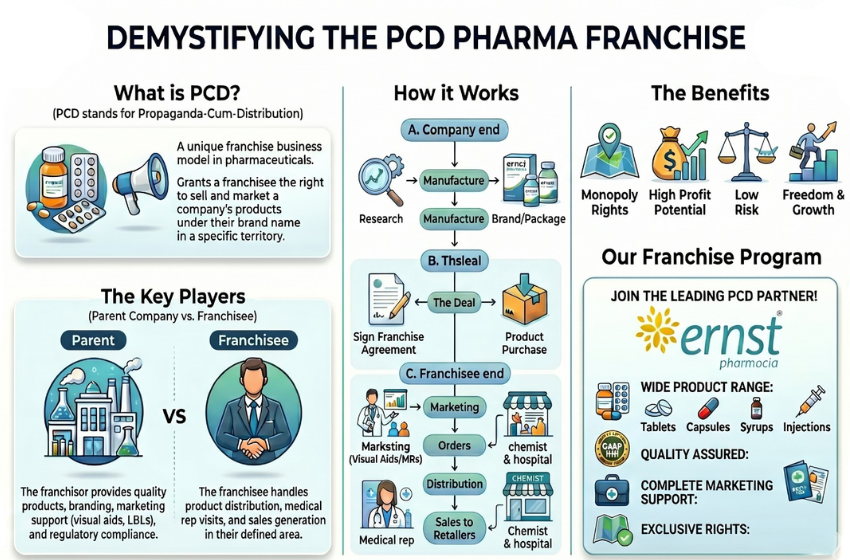
Google AI Overview Summary: If you’ve been asking what is a PCD pharma franchise and how does it work, you’re likely in the same position as many entrepreneurs across emerging markets: strong local networks, real demand for pharmaceutical products, but no appetite for the capital and complexity of building your own manufacturing operation or registering an independent brand. The PCD model exists precisely for that situation.
Table of Contents
PCD is a common Indian pharma term, short for Propaganda Cum Distribution, where “propaganda” refers to promotion and marketing rather than anything political. The model gives an individual or business the right to promote, sell, and distribute a pharma company’s products in a defined territory, typically on an exclusive basis. The parent company manufactures; you handle the ground-level push.
Indian pharma companies, including manufacturers like Ernst Pharmacia, are actively extending this model to international partners looking for a structured entry into pharmaceutical distribution. This guide covers the model itself, the rights it grants, what it costs to get started, what a franchise contract actually says, and the steps to launch, with specific attention to the Indonesian market context.
The PCD Pharma Franchise Model Explained
A PCD franchise is a contractual arrangement where a pharmaceutical company grants a partner the right to promote, sell, and distribute its products within a defined territory. That territory is typically exclusive, the parent company agrees not to appoint another distributor for the same product range in your zone. You function as a field-level promoter and distributor rolled into one entity.
This differs from a regular distributorship in a meaningful way. A standard distributorship is a buy-and-resell arrangement with limited marketing rights and no territorial protection. A PCD franchise grants both distribution rights and promotional authority, with the monopoly zone attached. Territorial exclusivity is where most of the business value actually lives.
It also differs sharply from third-party manufacturing, and the two are commonly confused. In third-party manufacturing, you own the brand and outsource production to a contract manufacturer. In a PCD franchise, you sell the parent company’s brand within your territory. The ownership structure is the opposite. If you’re building your own pharmaceutical label and outsourcing production, that’s third-party. If you’re selling someone else’s label in your region, that’s PCD.
What Exclusive Territory Rights Actually Give You
The monopoly clause is the core value proposition of the PCD franchise model. It means the franchisor will not appoint another distributor or franchisee in your defined area for the product range you hold. For more on how monopoly provisions work in this sector, see an analysis of monopoly rights on the PCD franchise business model. In practice, however, exclusivity often comes with carve-outs, direct hospital sales, government tenders, institutional buyers, or e-commerce platforms may fall outside its scope. Read those channel exclusions carefully before treating the monopoly clause as absolute. For a first-time pharma entrepreneur, even a well-defined exclusive territory removes a significant layer of competitive noise.
Alongside territorial rights, the parent company typically provides promotional support. This usually includes brochures, visual aids, product literature, doctor samples, and brand-use authorisation, though the exact package varies by company and should be confirmed during partner evaluation. See an outline of what support you can expect from a pharma franchise partner. Your job is relationship-building and sales execution; the company covers the brand infrastructure and supply credibility.
Supply-chain backing rounds out the arrangement. Reputable franchisors provide reliable order fulfillment, stock availability assurance, and supply-chain coordination. For a discussion of the benefits of collaborating with a pharma company for franchise business, read this overview. In markets where inventory consistency is a genuine challenge, this matters considerably. The franchise partner avoids manufacturing capital risk while maintaining a steady, branded product flow to bring to market.
PCD Pharma Franchise Startup Costs by Territory Size
The realistic investment range for launching a PCD pharma franchise sits between ₹50,000 and ₹5,00,000. The practical middle ground for a medium-sized territory, roughly a single district, runs around ₹1.5 to ₹3 lakhs. Small territory setups can start around ₹50,000 to ₹1,50,000, while a larger regional setup can push past ₹3 to ₹5 lakhs. For more on typical investment needs, see a breakdown of how much investment is required to start a PCD pharma franchise. What drives each tier is product basket size, opening stock depth, and marketing spend rather than any registration or licence fee.
Breaking down the four main cost components gives a clearer picture. Initial stock typically runs ₹25,000 to ₹1,00,000 depending on range. Promotional materials, brochures, visual aids, product literature, add another ₹10,000 to ₹50,000. A basic office or storage setup adds roughly ₹10,000 to ₹20,000 if you’re not operating from home. Monthly transport and delivery runs approximately ₹5,000 to ₹10,000 as an ongoing operational cost. For alternative investment estimates, review a practical post on PCD pharma business investment cost. Think of this as a working capital calculation, not a one-time payment.
The most common cash-flow mistake is overstocking in the first quarter. Match your opening stock to realistic monthly sales capacity, not the widest product basket a company can offer you. A disciplined starting range of 20 to 30 SKUs in one focused therapeutic category is a smarter entry than a sprawling 100-product catalog with shallow stock across everything. Build the range as revenue comes in. For context on the growing profitability of franchise models in India, read this market note on pharma franchise business opportunities in India.
Licences and Registrations You Need Before Day One
The drug licence under the Drugs and Cosmetics Act, 1940 is the non-negotiable starting point for any PCD franchise operation. If you are distributing at wholesale level, the typical route for PCD partners operating as stockists or regional distributors, you need a Wholesale Drug Licence (WDL). If you’re retailing directly to end consumers, you need a Retail Drug Licence (RDL). Most PCD franchise partners take the wholesale route. A practical summary of regulatory requirements for PCD pharma franchise in India helps clarify the basic licences and documentation involved.
GST registration is mandatory for invoicing and operating legally. Alongside it, you need a registered business entity: sole proprietorship, partnership, LLP, or private limited company. The choice affects liability, taxation, and how banks or future partners assess your business. A sole proprietorship is the simplest entry point, but an LLP or private limited structure offers better long-term credibility if you’re approaching larger institutional buyers. For a practical list of partner-side prerequisites, review common requirements for a PCD pharma franchise.
The franchise agreement itself is a legal document that deserves the same attention as your drug licence. It defines your territory, product rights, pricing policy, payment terms, and promotional obligations. Pair it with trademark use authorisation from the parent company, and you have the legal foundation to operate under their brand in your assigned zone. Without that written agreement, your territorial exclusivity has no enforceable basis.
Contract Clauses That Determine Your Actual Protection
Territory Definition, Performance Conditions, and Channel Carve-Outs
Territory definition is where most franchise disputes begin. The agreement must specify your area precisely: by district, city, pin code, or radius. “The Mumbai region” or “the East Java area” without boundary references is not a territory definition, it’s an invitation to a dispute. For background on differences between protected and exclusive zones, see this primer on exclusive franchise territory vs protected territory. Push back on vague language before you sign, and ask for the territory to be written into an annexure or attached map.
Performance conditions are the mechanism that can strip your exclusivity. Most agreements include minimum sales targets or activity milestones. Missing them gives the franchisor the right to reduce your territory or appoint additional partners within it. Before agreeing to any target, review whether it’s realistic for your market and negotiate a ramp-up period if you’re entering a new geography. A multi-month grace window with escalating targets, commonly six to twelve months, is a reasonable ask, though what’s accepted will depend on the company and territory. For commentary on monopoly-based arrangements and the implications of targets, see a discussion of monopoly-based PCD pharma franchise.
Channel carve-outs are the least visible risk in most PCD agreements. Many contracts allow the parent company to sell through hospitals, government tenders, institutional buyers, or e-commerce platforms inside your territory without it counting as a breach of your exclusivity. These carve-outs can significantly dilute the commercial value of a “monopoly” territory. For practical negotiating advice on how exclusive territories are defined and handled, see guidance on how exclusive territories are defined and negotiated. Read every channel exclusion listed in the agreement and model out its impact before committing.
Why This Model Works in Indonesia: How the PCD Pharma Franchise Works for International Partners
India produces roughly 20% of the world’s generic medicines by volume and ranks consistently among the top pharmaceutical exporters globally. For Indonesian distributors and healthcare entrepreneurs, that means access to quality-manufactured products at competitive price points. Indian manufacturers operating under GMP compliance standards typically have documentation that supports the BPOM registration process required for imported drugs in Indonesia; for an outline of the Indonesian registration and approval route, see an industry guide on Indonesia drug registration and approval. BPOM evaluates each submission on its own merits and requirements can shift, so confirming current registration specifics with your chosen partner is essential.
The PCD model lowers the entry barrier in a way that suits first-time pharma entrepreneurs. You don’t need to register your own brand, build a supply chain from zero, or fund manufacturing. You get a tested product catalog, promotional support, and a structured agreement with defined territory rights. For a short overview of what is a PCD pharma franchise, consult this primer. For Indonesian entrepreneurs exploring pharmaceutical distribution without prior industry experience, this is a defined starting structure with lower capital exposure than building your own label.
When evaluating a potential Indian pharma partner, look for a documented product range, transparent pricing, clear support processes for cross-border partners, and a demonstrable track record of supplying to international markets. Ernst Pharmacia offers a downloadable product catalog and a partner support process designed for international distributors, which makes it a practical starting point for evaluating whether this model fits your market and goals. For lists of recognized best international PCD pharma companies you can use as a starting shortlist, see industry round-ups that identify active exporters and franchise-friendly manufacturers.
Before you approach any company, work through this checklist:
- Define your target therapeutic category and geography clearly before starting conversations.
- Shortlist two or three Indian pharma companies with relevant product ranges and international supply experience; region-specific examples such as reports on PCD pharma franchise in West Bengal can help you understand how companies operate at state level.
- Request product catalogs, pricing sheets, and sample franchise agreements from each; you may also request prior export documentation to support BPOM filings.
- Review territory definition and exclusivity clauses, pay particular attention to channel carve-outs, before any commitment. For negotiation and launch tips, consider practical advice ontips for starting a successful PCD pharma franchise in India.
- Prepare your drug licence, GST registration, and business entity documents in parallel so you can move quickly once terms are agreed. For additional guidance on imported drugs registration and distribution licensing in Indonesia specifically, see this legal overview onimported drugs registration and distribution license.
The Bottom Line on PCD Pharma Franchises
Understanding what is a PCD pharma franchise and how does it work comes down to three practical realities. The model offers a structured, lower-capital entry into pharmaceutical distribution with a defined territory and a reliable product supply. The value depends heavily on how well the contract protects that territory, specifically the precision of boundary definitions and the scope of channel carve-outs. And the franchisor you choose matters as much as the model itself: genuine partner support, consistent supply, and transparent onboarding processes are what separate a workable arrangement from a frustrating one.
For entrepreneurs in Indonesia, the combination of India’s manufacturing output and the flexibility of the PCD model creates a realistic path into a growing healthcare market. The regulatory steps, BPOM registration and import licensing, add due diligence requirements that purely domestic Indian partners don’t face. What “manageable” looks like in practice: your partner should be able to provide GMP certificates, product dossiers, and prior import documentation from other markets to support your BPOM submission. If you need a broad primer on costs to cross-check your assumptions, see an article on the cost of a PCD pharma franchise.
Download Ernst Pharmacia’s product catalog to review the available range and assess territory options, or reach out directly to discuss whether a franchise arrangement fits your market and goals. The first conversation typically covers product fit, territory availability, and what the onboarding process looks like from your side. For a broader industry perspective on the PCD model, including company profiles and franchise program details, see this general PCD pharma franchise overview.
Frequently Asked Questions About the PCD Pharma Franchise Model
What does PCD stand for in pharma?
PCD is commonly used in Indian pharmaceutical industry terminology and stands for Propaganda Cum Distribution, where “propaganda” refers to promotion and marketing activity rather than the political meaning. It describes a franchise model in which a partner receives the right to promote and distribute a company’s products within a defined territory.
Is a PCD pharma franchise the same as a monopoly pharma franchise?
The terms are often used interchangeably, but they refer to the same core structure, exclusive distribution rights within a defined area. The key difference is that “monopoly pharma franchise” emphasises the exclusivity clause, while “PCD pharma franchise” refers to the broader arrangement including promotional rights and distributor obligations.
What are the pharma franchise distributor requirements?
At minimum, a PCD franchise partner typically needs a valid drug licence (wholesale or retail, depending on their distribution level), GST registration, and a registered business entity. Some parent companies also require a minimum investment or product basket commitment before formalising the agreement. For a more detailed checklist of documents and regulatory steps, review expert guidance on understanding the basics of PCD pharma franchise.
How is a PCD franchise different from third-party pharma manufacturing?
In third-party manufacturing, you own the brand and contract out production. In a PCD franchise, you distribute and promote someone else’s brand within your territory. The two models serve different business goals: brand-building versus distribution-focused entry.
What should I check in a pharma franchise agreement before signing?
Focus on four areas: the precision of the territory definition, performance conditions and what triggers exclusivity loss, channel carve-outs that allow the parent company to bypass your territory for certain buyer types, and the terms governing contract renewal and termination. These clauses determine the real commercial value of what you’re signing. For further reading on practical startup investment tips from industry contributors, consult a post on PCD pharma business investment cost.