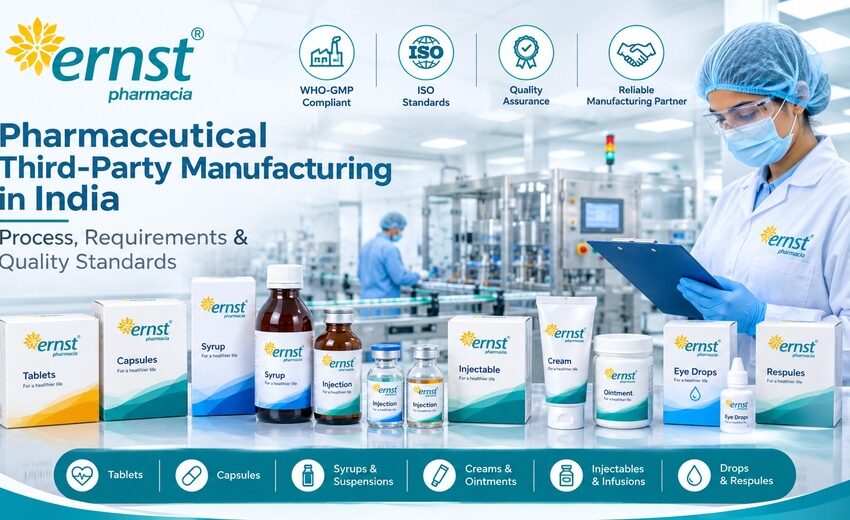
Pharmaceutical third-party manufacturing is a business arrangement in which a company gets pharmaceutical products manufactured through an external manufacturing facility instead of producing them entirely at its own factory.
This model can help pharmaceutical businesses develop product portfolios without investing in all the infrastructure required to operate a manufacturing facility. However, it still requires careful planning, appropriate regulatory arrangements, product-specific documentation and quality oversight.
For companies considering third-party manufacturing, the main priorities should be manufacturing capability, product quality, regulatory compliance, clear commercial terms and reliable supply.
1. What Is Pharmaceutical Third-Party Manufacturing?
Third-party pharmaceutical manufacturing involves an arrangement between a business that needs pharmaceutical products and a manufacturing company that produces those products under agreed conditions.
Depending on the arrangement, the parties may coordinate:
- Product and formulation selection.
- Manufacturing feasibility.
- Packaging and labelling.
- Batch production.
- Quality-control activities.
- Product documentation.
- Regulatory responsibilities.
- Storage and dispatch.
The exact responsibilities depend on the contract, product category and applicable regulatory requirements.
For example, Ernst Pharmacia is a Pharmaceutical company may want to introduce a range of tablets, capsules or syrups without establishing a new production line. It can evaluate qualified manufacturers with the relevant facilities and licences to determine whether the required products can be manufactured under an appropriate arrangement.
Third-party manufacturing does not remove the need to verify product quality or comply with pharmaceutical regulations.
2. Why Do Pharmaceutical Companies Choose Third-Party Manufacturing?
Businesses may consider third-party manufacturing for several reasons.
Reduced need for manufacturing infrastructure
Establishing a pharmaceutical production facility requires premises, equipment, trained personnel, quality systems and regulatory approvals. Using an external manufacturer may reduce the need for a business to own and operate all these resources itself.
Access to specialised facilities
Different dosage forms require different production capabilities. A manufacturer specialising in tablets may not necessarily have the equipment or authorisations required for sterile injectables.
Working with an appropriate manufacturing partner can provide access to facilities suited to the required dosage form.
Product portfolio expansion
Businesses may want to introduce additional formulations without establishing a new production line for every product.
Focus on business development
Depending on the business model, a company may concentrate on product planning, distribution, marketing and customer relationships while manufacturing is performed by an external facility.
Potential operational flexibility
Manufacturing arrangements can be evaluated according to product requirements, quantities, packaging and production capacity. Actual flexibility depends on the manufacturer’s capabilities and commercial terms.
3. Which Pharmaceutical Products Can Be Manufactured Through Third Parties?
The available products depend on the manufacturing facility, its licences, equipment and technical capabilities.
Common dosage-form categories include:

Tablets
Conventional tablets, coated tablets and selected modified-release formulations may be manufactured at facilities equipped and authorised for the relevant processes.

Capsules and soft gelatin capsules
Manufacturing capabilities depend on the formulation, capsule type, equipment and required quality controls.

Syrups and oral suspensions
Liquid formulations require suitable preparation, filling, packaging and quality-control systems.

Creams, ointments and gels
Topical products require suitable formulation, mixing, filling and packaging capabilities.

Injectables and infusions
These products require specialised facilities, appropriate controls and compliance with the relevant requirements for sterile pharmaceutical manufacturing.
Other specialised products may include eye drops, nasal preparations, respules and nutraceutical formulations, depending on the manufacturer’s authorised capabilities.
These are examples of common dosage forms, not a guarantee that every third-party manufacturer offers all of them.
4. How Does the Third-Party Manufacturing Process Work?
A structured process helps businesses understand responsibilities before production begins.
Step 1: Define the product requirement
Identify the required products, compositions, strengths, dosage forms, pack sizes and expected quantities.
If you are developing a new product, additional formulation and regulatory considerations may apply.
Step 2: Identify a suitable manufacturer
Shortlist manufacturers that have the relevant facilities, technical expertise, licences and production capacity for your requirements.
Do not choose a manufacturer solely because it offers the lowest quotation.
Step 3: Evaluate manufacturing capabilities
Ask about the proposed production site, available equipment, quality-control arrangements, relevant certifications and experience with the required dosage form.
Verify that the facility’s authorisations cover the intended products and activities.
Step 4: Discuss product specifications
The manufacturer and contracting business should establish the applicable product specifications, packaging requirements, approved labelling and other technical details.
Any changes should be managed through an appropriate approval and documentation process.
Step 5: Finalise the commercial agreement
The agreement should define pricing, minimum order quantity, payment terms, responsibilities, timelines, quality expectations, documentation and handling of rejected or non-conforming batches.
Step 6: Complete regulatory and documentation requirements
Confirm the licences, permissions, product approvals and other documentation required for the particular product and arrangement.
Responsibilities should be clearly allocated between the parties.
Step 7: Manufacture and perform quality checks
The manufacturing facility follows the approved procedures and applicable quality controls for the product.
Manufacturing and testing records should be maintained as required.
Step 8: Review release documentation
Before dispatch, verify that the relevant batch has completed the required testing, review and release procedures.
Step 9: Package and dispatch the products
Products are packed, labelled, stored and dispatched according to the applicable requirements and agreed commercial conditions.
Step 10: Maintain post-supply communication
The parties should have a clear process for complaints, product-quality concerns, recalls where necessary and other post-supply responsibilities.
5. Pharmaceutical Manufacturing Quality Standards in India
Quality standards are central to pharmaceutical manufacturing because product quality cannot be established by inspecting the finished medicine alone.
India pharmaceutical manufacturing requirements include applicable provisions of the Drugs and Cosmetics Rules, including Schedule M, which addresses Good Manufacturing Practices and requirements for premises, plant and equipment.
The Central Drugs Standard Control Organisation (CDSCO) published a circular on 7 August 2024 regarding implementation of revised Schedule M requirements. Businesses should verify the current regulatory position and the applicable compliance status of the proposed manufacturing facility.
What should businesses verify?
- Valid manufacturing licences for the relevant activities.
- Applicable GMP requirements and compliance status.
- Suitability of the manufacturing premises and equipment.
- Quality-control laboratory capabilities.
- Documented production procedures.
- Batch manufacturing and testing records.
- Product-specific regulatory documentation.
- Appropriate storage and distribution arrangements.
Important: A company should not assume that every product or facility has identical certifications. Ask for evidence relevant to the actual manufacturing site and product.
6. What Is Quality Control in Third-Party Manufacturing?
Quality control involves the checks and tests used to determine whether materials and finished products meet established specifications.
The specific testing programme depends on the formulation and applicable standards.
Raw-material testing
Starting materials should be assessed according to approved specifications and applicable procedures before use.
In-process checks
Manufacturing operations may include checks on parameters such as weight, dimensions, mixing, filling or other relevant characteristics.
Finished-product testing
The finished product is tested against applicable specifications before release.
Packaging checks
Packaging and labelling should be checked to ensure they meet the approved requirements.
Batch documentation
Manufacturing, testing and release records should be maintained according to applicable requirements.
Stability studies
Where required, stability studies help establish how a product’s quality changes under specified storage conditions and support its assigned shelf life.
A business evaluating a third-party manufacturer should ask which tests apply to its specific product and what documentation can be supplied.
7. What Documents Should You Request?
Documentation depends on the product, the manufacturing arrangement and regulatory requirements.
Before entering an agreement, ask which of the following are applicable and available:
| Document or record | Why it matters |
|---|---|
| Manufacturing licence | Helps verify authorised manufacturing activities |
| Applicable GMP documentation | Supports assessment of manufacturing compliance |
| Product specifications | Defines the required product characteristics |
| Approved product information | Establishes composition, strength and other product details |
| Batch manufacturing records | Documents the production process |
| Certificate of Analysis (CoA) | Reports relevant test results for a batch |
| Stability information | Supports shelf-life and storage requirements |
| Packaging and labelling specifications | Defines approved packaging and label details |
| Product approvals or permissions | Establishes applicable regulatory authorisation |
| Quality agreement | Defines quality responsibilities between the parties |
Not every document is applicable in the same form to every arrangement. The contracting parties should confirm the required documentation before production begins.
8. How to Choose the Right Third-Party Pharmaceutical Manufacturer
Selecting a manufacturer requires technical, regulatory and commercial evaluation.
Manufacturing experience
Check whether the company has experience with your required dosage form and product category.
Facility suitability
Verify that the facility has the necessary equipment, technical staff and authorisations.
Quality systems
Review applicable quality procedures, testing capabilities and documentation.
Regulatory compliance
Check the current status of relevant licences and certifications directly with appropriate records or authorities.
Production capacity
Ask whether the facility can handle the expected batch size and production requirements.
Minimum order quantity
Determine the MOQ for each product, pack size and proposed manufacturing arrangement.
Commercial transparency
Compare the complete quotation, including packaging, testing, development charges where applicable, taxes, freight and other costs.
Communication and accountability
Clarify who is responsible for product specifications, approvals, changes, complaints and supply coordination.
Supply planning
Ask for an estimated production schedule based on the product’s actual requirements, material availability and regulatory status.
9. What Is the Minimum Order Quantity (MOQ)?
MOQ is the minimum quantity a manufacturer agrees to produce or supply under specified conditions.
There is no universal MOQ for all pharmaceutical Products.
The requirement may depend on:
- Dosage form.
- Batch size.
- Product composition.
- Packaging configuration.
- Availability of raw materials.
- Printing and packaging requirements.
- Whether the product is already established or requires development.
For example, a tablet product and a specialised liquid formulation may have different minimum production requirements.
Always request a written, product-specific MOQ before finalising your business plan.
10. How Long Does Third-Party Manufacturing Take?
The production timeline depends on the product and the status of the order.
Factors can include:
- Product and formulation readiness.
- Regulatory approvals or permissions.
- Availability of raw and packaging materials.
- Production scheduling.
- Batch size.
- Testing and quality review.
- Packaging and labelling approval.
- Dispatch arrangements.
A standard repeat order may follow a different schedule from a new product requiring additional development or approvals.
Ask the manufacturer for an estimated timeline and clarify which stages are included. Avoid relying on an assumed universal delivery period.
11. Understanding Pharmaceutical Manufacturing Costs
The total cost of a third-party manufacturing order can include more than the basic manufacturing price.
Depending on the arrangement, costs may involve:
- Raw materials.
- Manufacturing operations.
- Quality-control testing.
- Packaging materials.
- Printing and labelling.
- Product development, where applicable.
- Regulatory-related work.
- Taxes.
- Freight and logistics.
- Other agreed services.
When comparing quotations, ensure that the same product specifications, batch quantities, packaging and testing requirements are being compared.
A lower quotation may not represent better value if it excludes essential services or documentation.
12. Third-Party Manufacturing vs. Own Manufacturing
Both models have different operational requirements.
| Factor | Third-party manufacturing | Own manufacturing facility |
|---|---|---|
| Production infrastructure | Provided through an external manufacturer | Established and operated by the business |
| Initial infrastructure commitment | May be lower | Usually substantially higher |
| Production control | Shared according to the agreement | Direct operational control, subject to regulations |
| Equipment | External facility’s equipment | Business’s own equipment |
| Quality responsibilities | Must be clearly allocated | Managed within the business’s quality system |
| Capacity planning | Depends on the manufacturing partner | Depends on owned facility capacity |
| Regulatory requirements | Apply according to the parties’ roles and activities | Apply to the manufacturing operation and products |
Third-party manufacturing may suit businesses that want access to production capabilities without establishing their own factory. It does not eliminate the need to comply with applicable product and regulatory requirements.
13. Third-Party Manufacturing Services at Ernst Pharmacia
Ernst Pharmacia lists third-party manufacturing as one of its business services on its official website. Its contact page also provides a dedicated contact number for third-party contract manufacturing.
Businesses considering Ernst Pharmacia can use the following process to assess whether the service fits their needs.
Define your product requirements
Prepare the desired composition, strength, dosage form, packaging and estimated quantity.
Discuss manufacturing feasibility
Ask which products and dosage forms can be supported and which facility would manufacture them.
Request commercial details
Confirm MOQ, pricing, payment terms, packaging charges and estimated production timelines.
Verify quality and regulatory documentation
Ask for the applicable licences, manufacturing-site details, certifications and product-specific documentation.
Confirm the responsibilities
Agree on product specifications, artwork approval, testing, batch release, supply, complaints and other relevant responsibilities.
Ernst Pharmacia published product portfolio includes a broad range of therapeutic categories. However, the availability of a particular product for third-party manufacturing should be confirmed directly rather than assumed from its appearance in the product catalogue.
Contact details: The official Ernst Pharmacia contact page lists a dedicated third-party contract manufacturing contact number: +91 8264096723. Verify the current contact details on the official website before reaching out.
14. Questions to Ask Before Signing a Manufacturing Agreement
Before approving an order, obtain clear answers to these questions:
- Which facility will manufacture the product?
- Does its licence cover the intended manufacturing activity?
- Which applicable GMP standards and certifications can be verified?
- What are the product specifications and approved composition?
- What tests will be performed, and what records will be supplied?
- What is the minimum order quantity?
- What is included in the quoted price?
- Who approves the artwork and labelling?
- What is the estimated production and delivery timeline?
- Who is responsible for regulatory submissions and product permissions?
- How will non-conforming batches and complaints be handled?
- What happens if raw materials, packaging or production schedules change?
Document the agreed answers in the contract or relevant quality agreement wherever appropriate.
15. Common Mistakes in Third-Party Manufacturing
Choosing a manufacturer based only on price
Price is important, but it should not replace quality, technical and regulatory evaluation.
Assuming certifications cover every product
Verify the relevant manufacturing site, scope and validity of documentation.
Ignoring product specifications
Composition, strength, dosage form, packaging and testing requirements should be defined before production.
Failing to allocate responsibilities
The parties should clearly agree who handles approvals, documentation, quality issues and complaints.
Underestimating the MOQ
Confirm minimum quantities and the cost of packaging materials before committing to an order.
Assuming fixed delivery times
Ask for a realistic, product-specific schedule and understand possible dependencies.
Neglecting post-supply responsibilities
Contracts should explain how product complaints, quality concerns and potential recalls are managed.
Frequently Asked Questions
1. What is third-party pharmaceutical manufacturing?
Third-party pharmaceutical manufacturing is an arrangement in which a business engages an external pharmaceutical manufacturer to produce products under agreed specifications and regulatory conditions. The parties define the manufacturing, quality, documentation and commercial responsibilities.
2. Is third-party manufacturing legal in India?
It can be conducted under applicable Indian pharmaceutical laws and regulations when the required licences, permissions, product approvals and other regulatory requirements are met. The specific requirements depend on the product and the arrangement.
3. Does Ernst Pharmacia offer third-party manufacturing?
Yes. Ernst Pharmacia lists third-party manufacturing as a business service on its official website. Product feasibility, the manufacturing facility, MOQ, documentation and commercial terms should be confirmed directly with the company.
4. Which products can be manufactured through a third-party arrangement?
Depending on the facility and its authorisations, products may include tablets, capsules, syrups, suspensions, creams, ointments, drops, injectables and other formulations. Each product must be assessed individually.
5. What is MOQ in pharmaceutical manufacturing?
MOQ means minimum order quantity. It varies according to the product, dosage form, batch size, packaging and manufacturing requirements. Request a product-specific quotation rather than assuming one fixed quantity.
6. What quality documents should I request?
Depending on the arrangement, relevant documents may include manufacturing licences, applicable GMP documentation, product specifications, batch records, Certificates of Analysis, stability information and product approvals or permissions.
7. How do I verify a pharmaceutical manufacturing facility?
Review the relevant manufacturing licence, facility details, applicable certifications and regulatory documentation. Verify that the facility is authorised for the specific product and activity.
8. How long does third-party pharmaceutical manufacturing take?
The timeline depends on product readiness, raw materials, production capacity, testing, packaging, approvals and dispatch. Ask for a written estimate for the particular order.
9. Can a business use third-party manufacturing without owning a factory?
An eligible business may be able to use a third-party manufacturing arrangement without owning a production facility. However, its own licensing, regulatory, marketing and other obligations depend on its role and the applicable requirements.
10. What should a third-party manufacturing agreement include?
It should clearly define the products, specifications, manufacturing site, responsibilities, quality requirements, documentation, commercial terms, delivery schedule, complaint handling and other relevant obligations.
Third-party pharmaceutical manufacturing can help businesses access suitable production capabilities without establishing every part of their own manufacturing infrastructure. However, the arrangement requires careful evaluation of the manufacturer, product specifications, regulatory status, quality systems, documentation, MOQ and commercial terms.
For businesses considering this model with Ernst Pharmacia, the next step is to discuss the intended products and quantities, confirm the proposed manufacturing facility and request the relevant quality and regulatory documentation.
The priority should be a suitable, compliant and clearly documented manufacturing arrangement—not simply the lowest price or the largest product list.